


Skel and the Skeleton Crew love to learn new things! Here are some fantastic educational stories to share with your friends:
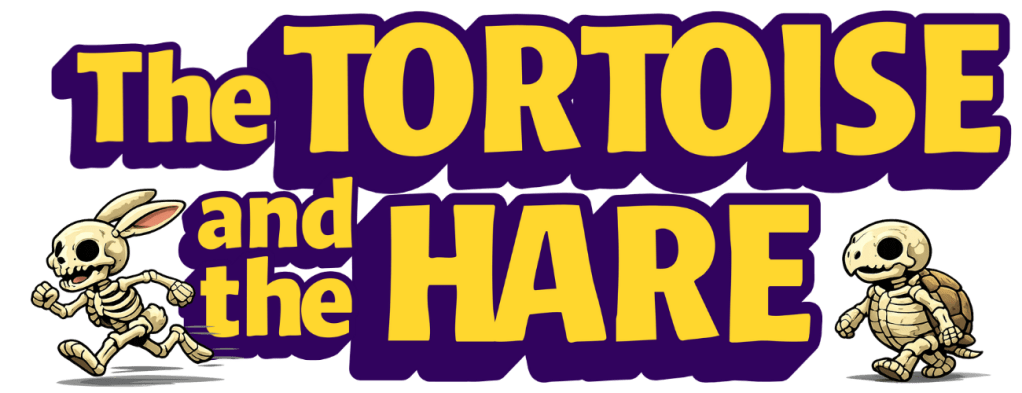
A skeleton hare named Bony Rabbit was making fun of Skelshell the skeletortoise one day for being so slow.
“Do you ever get anywhere?” Bony Rabbit asked with a mocking laugh.
“Yes,” replied Skelshell, “and I get there sooner than you think. I’ll run you a race and prove it.”
Bony Rabbit was much amused at the idea of running a race with Skelshell, but for the fun of the thing he agreed. So the Fox, who had consented to act as judge, marked the distance and started the runners off.
Bony Rabbit was soon far out of sight, and to make Skelshell feel very deeply how ridiculous it was for him to try a race with a skeleton hare, he lay down beside the course to take a nap until the skeletortoise should catch up.
Skelshell meanwhile kept going slowly but steadily, and, after a time, passed the place where Bony Rabbit was sleeping. But the skeleton hare slept on very peacefully; and when at last he did wake up, Skelshell was near the goal. Bony Rabbit now ran his swiftest, but he could not overtake Skelshell in time.
The race is not always to the swift.
Source: “The Hare & the Tortoise” from the Aesop for Children at the Library of Congress (https://read.gov/aesop/025.html)

A young shepherd named Skelboy tended his master’s sheep near a dark forest not far from the village. Soon he found life in the pasture very boring. All he could do to for fun was to talk to his dog or play on his shepherd’s pipe.
One day as he sat watching the sheep and the quiet forest, and thinking what he would do should he see a skelwolf, he thought of a plan to amuse himself.
His master had told him to call for help should a skelwolf attack the flock, and the villagers would drive it away. So now, though he had not seen anything that even looked like a skelwolf, he ran toward the village shouting at the top of his voice, “Skelwolf! Skelwolf!”
As he expected, the villagers who heard the cry dropped their work and ran in great excitement to the pasture. But when they got there they found Skelboy doubled over with laughter at the trick he had played on them.
A few days later, Skelboy again shouted, “Skelwolf! Skelwolf!” Again the villagers ran to help him, only to be laughed at once more.
Then one evening as the sun was setting behind the forest and the shadows were creeping out over the pasture, a skelwolf really did spring from the underbrush and fall upon the sheep.
In terror, Skelboy ran toward the village shouting “Skelwolf! Skelwolf!” But though the villagers heard the cry, they did not run to help him as they had before. “He cannot fool us again,” they said.
The skelwolf stole a great many of Skelboy’s sheep and then slipped away into the forest.
Liars are not believed even when they speak the truth.
Source: “The Shepherd Boy & the Wolf” from the Aesop for Children at the Library of Congress (https://read.gov/aesop/043.html)

There was once a skeleton man named Jaskull who had the most wonderful skelgoose you can imagine, for every day when he visited the nest, the skelgoose had laid a beautiful, glittering, golden egg.
Jaskull took the eggs to market and soon began to get rich. But it was not long before he grew impatient with the skelgoose because she gave him only a single golden egg a day. He was not getting rich fast enough.
Then one day, after he had finished counting his money, the idea came to him that he could get all the golden eggs at once by giving the skelgoose a great fright.
Jaskull hid behind a tree near the skelgoose’s favorite pond. When the skelgoose finished swimming around and climbed out of the water, Jaskull jumped out and screamed, “Boo!”
The skelgoose was so scared, it flapped its wings, and flapped them so hard that it flew off into the sky. The skelgoose didn’t lay a single golden egg, and Jaskull wouldn’t get any more of them now.
Those who have plenty want more and so lose all they have.
Source: “The Goose & the Golden Egg” from the Aesop for Children at the Library of Congress (https://read.gov/aesop/091.html)
 Lightbrand Productions